Answering Technical Interview Questions

Introduction to Technical Questions

Technical questions are an essential part of the interviewing process.  These questions are designed to test a candidate's abilities as they pertain to the position they're applying for.  They can be used to test general knowledge within that industry or to determine a candidate's "hard" skills. Overall, technical questions will let the interviewer know if the candidate is able to perform the day-to-day operations associated with that position. 

When answering technical questions, candidates may be expected to apply their knowledge to real-world scenarios and are often assessed on the logical process they utilize to solve a problem. 

Why Do Interviewers Ask Technical Questions?

Interviewers ask technical questions because it helps them separate qualified candidates from unqualified ones.  It's estimated that it costs 10-20% of a new employee's salary to train them, so interviewers want to make sure they select the right hire to invest in. 

These questions can range from broad understanding of the industry to inquiries about specific problems you will see on the job. 

What Do Interviewers Expect When Asking Technical Questions?

When interviewers ask technical questions, they expect candidates to show them that they are technically qualified for that position. Therefore, when you are answering technical questions, you should:

Give a detailed account of  your thought process

Give a detailed account of your thought process

The interviewer wants to know how you will react to certain obstacles that may come up in the workplace.  Give a detailed account of what steps you would take and why you would take those steps.  This will give the interviewer insight about what they can expect from working with you. 

Communicate clearly

Communicate clearly

Technical questions aren't just about what you know; they're also about how you communicate that knowledge.  If you know all of the material but aren't able to communicate that information to the management team in a way they can understand, this may signal a red flag to the interviewer. 

Show your enthusiasm

Show your enthusiasm

Not only do you want to show the interviewer that you are qualified for the job, but you also want to show them you're enthusiastic about the industry you're in.  Displaying knowledge of emerging trends, growth, and recent news within our industry shows the interviewer that you are self-motivated and driven. 

How to Prepare for Technical Questions

"When done properly, the questions you get in a technical interview are ones that you won't have heard before" - Gayle McDowell, "Cracking the Code"

While there are some common technical questions that you can expect to be asked, the interviewer will also have done their best to come up with questions you haven't heard before. 

Technical questions are meant to test your analytical skills, so they are often more difficult than other types of questions you might be asked in an interview.  This means that you need to be diligent about your preparation. 

Think of the technical questions in an interview like an exam.  You've been going to class and have a general idea of the subject matter from your day-to-day job responsibilities.  Now it's time to brush up on your knowledge and review the specifics.

Follow these easy steps to make sure you're ready:

Make sure  your foundation is steady

Make sure your foundation is steady

Go back to the basics.  Most technical questions will require you to build off of the basic groundwork of your knowledge, so it's important that these concepts are fresh in your mind.  Taking a couple of hours to go over your foundational knowledge will also help you feel more confident going into the interview. 

Do your research

Do your research

Go back to the original job post and review the requirements and day-to-day responsibilities since this is what the interviewer will test your knowledge on.  If a technical interview is an exam, think of the job post as the syllabus that outlines the key topics.  It also helps to look at employee reviews on websites such as  Glassdoor or Monster.  People often give insight into the hiring process which can help you prepare. 

Practice

Practice

The best way to improve your interviewing skills is to take practice mock interviews.  Follow the steps outlined in the Assignment section to take a practice technical interview in our online Interview Simulator tool.  The simulator will give you meaningful technical questions tailored to your position. 

Common Technical Questions Across Every Industry

Within every industry, there are certain technical questions that interviewers love to ask, regardless of the position you’re applying for. Here are some of the technical skills categorized by discipline:

Other Interview Question Types

Technical questions aren't the only kind of questions that get asked frequently.  We've compiled a list of common question types you can expect to be asked during an interview and what you can do to prepare for them!

Illegal and Inappropriate Questions

"How old are you?"

"Are  you married?"

"Do you plan on having children anytime soon?"

While these questions may seem innocent, they are actually illegal to ask during an interview.  Common illegal and inappropriate questions include those about:

Although it may seem like the interviewer is just trying to get to know you, answering questions about these topics can actually hurt your chances for getting the job. Interviewers can develop biases about you that may not be true or have anything to do with your work ethic.

For instance, an interviewer may develop a bias against a candidate after learning they have children. This knowledge may lead them to believe they won’t be able to devote as much time and energy to the job as someone without children — something that is not necessarily true.

If an interviewer is asking you questions that make you uncomfortable but you’re not sure if they are illegal, consider this: does the question they’re asking you have anything to do with your skills or job experience as they pertain to the position you’re applying for?

If not, there are a few ways you can respond to illegal questions.

How to Respond to Illegal Questions

Illegal or inappropriate questions can cause you to feel uncomfortable or embarrassed, and you are absolutely not required to answer them.  If an inappropriate question comes up, there are a few ways you can reply that won't reveal personal information about yourself. You can:

Redirect the question to the interviewer

Redirect the question to the interviewer

One of the most effective ways to handle an illegal question is to redirect it back to the interviewer.  Not only does it draw their focus off of you and onto themselves, but it also gives you more information about the person interviewing you.  This helps to distract the interviewer from their original question. 

Illegal Question: "Do you have any children?"
Response: "I'm committed to a career regardless of my family status.  I also noticed the company does a great job of promoting a healthy work-life balance for employees. What has your experience been with that?"

Avoid answering the question

Avoid answering the question

It can be hard to think of a way to redirect the interviewer on the spot, especially if you know nothing about them.  In that case, avoiding answering the question in a graceful manner could be your best bet when handling an inappropriate question.  Using this tactic, you can avoid answering the question while still acknowledging that the interviewer has asked you something. 

Illegal Question: "When did you first start working?"
Response: "I have a wealth of knowledge and experience in this field and am happy to answer questions about any of the jobs listed on my resume."

Keep your answers broad

Keep your answers broad

Sometimes there's just no way to avoid the question - when this happens, just keep your answers broad and vague.  You want to reveal as little information about yourself as possible while still seeming agreeable.  Keeping your answer broad will prevent the interviewer from developing unfair biases toward you while still answering their questions. 

Illegal Question: "What years did you attend XYZ University?"
Response: "I am proud to have obtained my degree at XYZ University.  I assure you that I keep up with the latest technologies in this field and maintain my credentials by attending continuing education classes."

Be direct

Be direct

Sometimes, a situation calls for a direct approach.  If you feel uncomfortable answering any questions and don't feel the need to continue that certain conversation thread, you are completely within your rights to tell the interviewer that you don't think it's appropriate.  Be aware that some interviewers may it may not like to be challenged and could develop a bias towards you that may jeopardize your chances at getting the job. 

Illegal Question: "What country were you born in?"
Response:  "I'm not sure how this is an appropriate question.  How does this relate to my qualifications for the job?"

Address the

Address the

Consider what the interviewer may really be asking.  A question about health or medical issues might really be about physical abilities.  You can address this without going into detail about any medical conditions you have. 

Illegal Question: "Do you have any serious medical issues?"
Response: "I understand the physical job requirements and will have no problem fulfilling the duties."

Keep in mind that sometimes an interviewer may be inexperienced or unaware that the questions they are asking are inappropriate.  It's best to be diplomatic in your answers and attempt to keep the interview moving.  Often, a polite, "What does this question have to do with the position I'm applying for?" is more than enough to redirect an interviewer who continues to ask illegal questions. 

You have a right to file a Charge of Discrimination if you believe an employer has discriminated against you based on race, color , religion, sex (including pregnancy, gender identity, and sexual orientation), national origin, age (40 or older), disability, or genetic information.  For more information, visit the U.S. Equal Employment Opportunity Commission (EEOC) website at https://www.eeoc.gov/employees/charge.cfm

The legality of interview questions largely depends on what state you live in and what type of job you are interviewing for.  Check to see if your state or municipality has Ban the Box laws in effect which make it illegal for employers to ask job applicants about their criminal history until a specified point in the hiring cycle. 


We've covered a good about of information in this guide, but that's not all!

Now that we've covered how you can answer technical questions, stay tuned for the next part of our exclusive training program:

Questions to Ask the Interviewer, where we'll go over topics such as: 

  • Why it's so important to ask the right questions. 
  • What a great question looks like. 
  • What kind of questions you should never bring up in an interview.

Assignment

Practice makes perfect! The best way to improve your interviewing skills is to take mock interviews. Our online Interview Simulator tool makes taking practice interviews easy. 

In the previous assignment, you took a practice behavioral interview. Now, follow these steps to take a practice technical interview to implement the strategies you learned in this guide: 

Image

Step 1

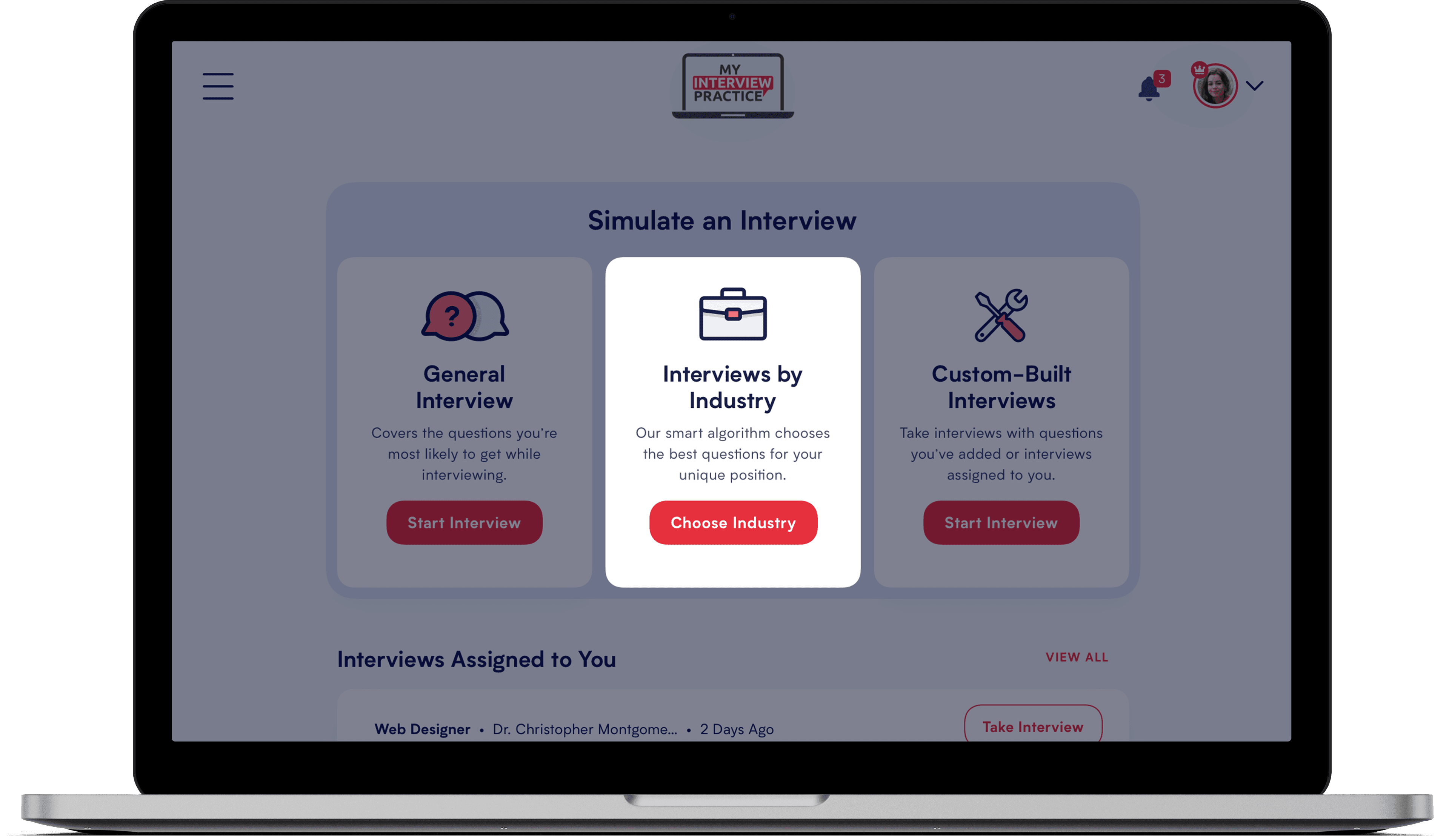
From the dashboard, click on the “Choose Industry" button in the "General Interview" section. These interviews will cover technical questions specific to the unique position you are applying for.

Image

Step 2

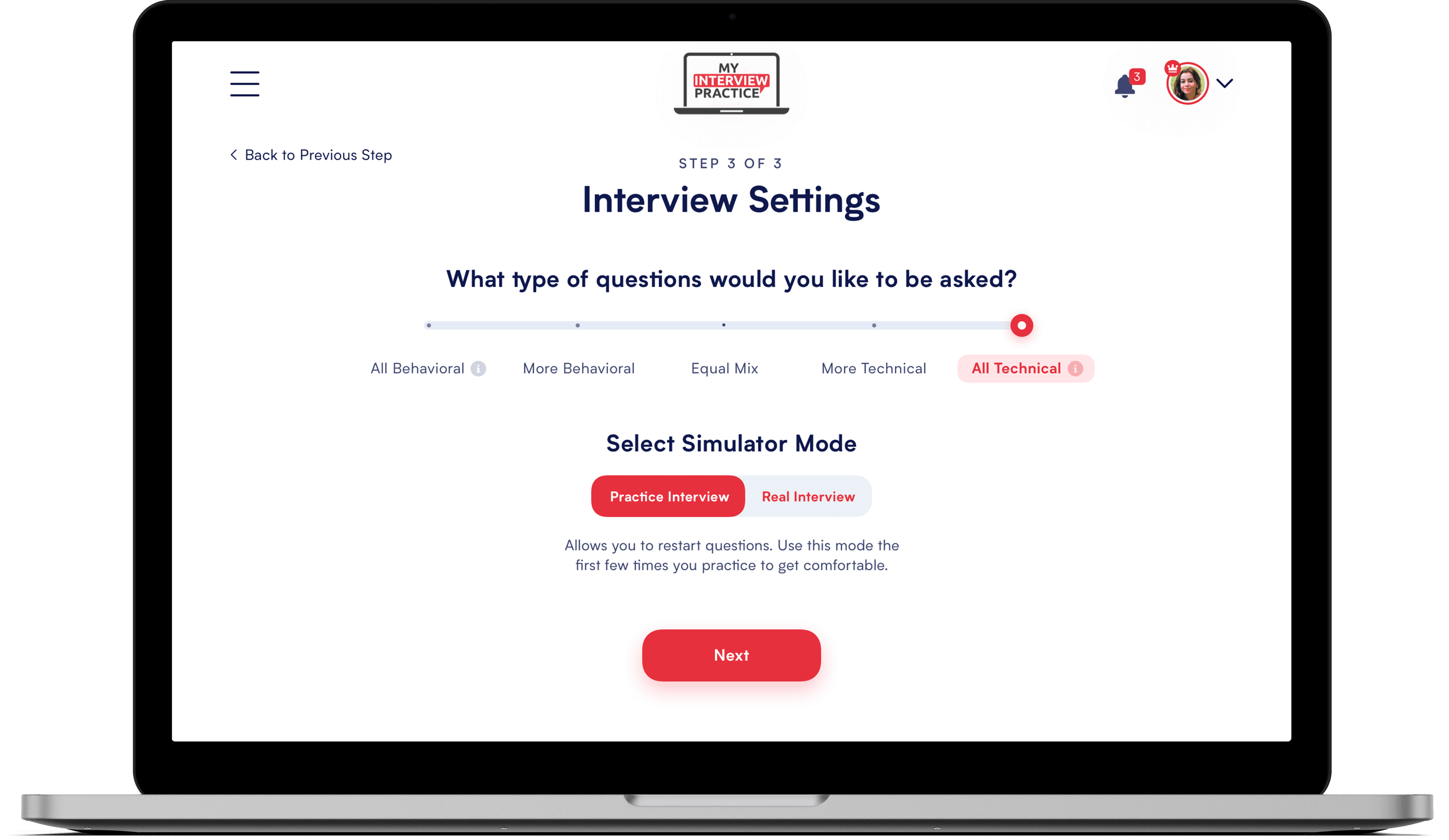
Next, choose the target industry and position you will be interviewing in.  The tool will take you through the type of interview you want to take. Be sure to select "All Technical" for the question "What type of questions you would like to be asked?" Based on all of these selections, our algorithm will instantly begin curating an interview script of what questions should be asked.

Image

Step 3

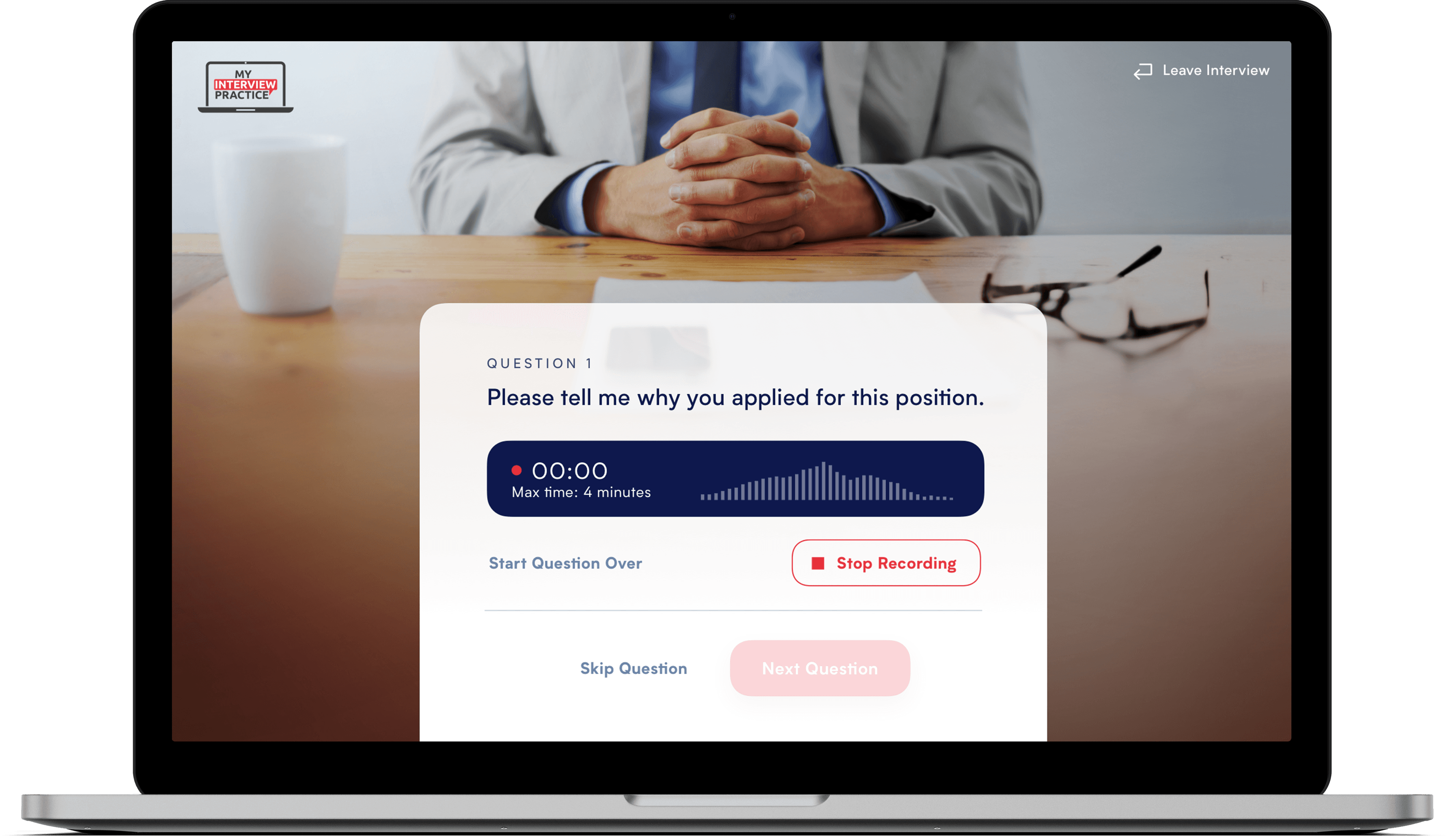
When you start practicing in the Interview Simulator, you won't know the questions, just like a real interview! As questions appear on the screen, the simulator will record your responses. After you've completed an interview, be sure to review your responses. In the final summary section it will show you how to objectively rate your interview recording so you can better understand what interviewers may be looking for.